*** ATTENTION U.S. CUSTOMERS ***
Please remember that there is a Tariff (aka Duty & Import Tax) that you must pay directly to U.S. Customs when your parcel arrives in the U.S.
*** IMPORTANT SHIPPING & DELIVERY NOTICE ***
Some international couriers continue to experience shipping delays.
We recommend you buy early and in bulk to avoid the impact of these delays.For 25+ years, we've been supporting a Healthy Body, Strong Spirit and Clear Mind!
Providing superior quality medicinal mushroom supplements
to customers in 74 countries around the world.Buy More & SAVE Big


- Tap for Navigation
- Dietary Supplements ▼
- » Dr Alla's Cordyceps
- » Dr Alla's Lion's Mane
- » Dr Alla's Maitake
- » Dr Alla's Reishi
- » Dr Alla's Shiitake
- » Testimonials
- Symptoms Chart
- Get Advice ▼
- » FAQ
- » Health Consultations
- Dr Alla's Insights ▼
- » Medical Conditions
- » Mushroom Properties
- » Research Info ►
- » » Medical Quotes
- » » Reference Works
- » » Mushrooms - Why Special?
- About ▼
- » Dr Alla's Story
- » Testimonials
- » Trade Enquiries
- » Contact
- Customer Info ▼
- » Access My Account
- » Track My Order
- Navigation
- Dietary Supplements ▼
- » Dr Alla's Cordyceps
- » Dr Alla's Lion's Mane
- » Dr Alla's Maitake
- » Dr Alla's Reishi
- » Dr Alla's Shiitake
- » Testimonials
- Symptoms Chart
- Get Advice ▼
- » FAQ
- » Health Consultations
- Dr Alla's Insights ▼
- » Medical Conditions
- » Mushroom Properties
- » Research Info ►
- » » Medical Quotes
- » » Reference Works
- » » Mushrooms - Why Special?
- About ▼
- » Dr Alla's Story
- » Testimonials
- » Trade Enquiries
- » Contact
- Customer Info ▼
- » Access My Account
- » Track My Order
Dr Alla’s Maitake Mushrooms
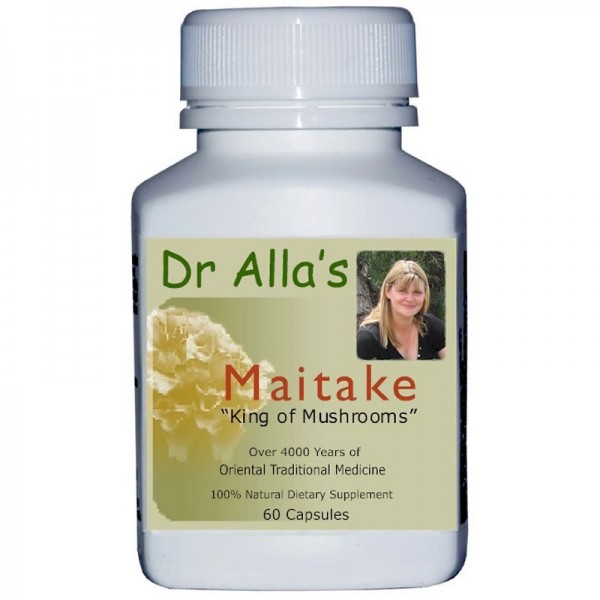
"King of Mushrooms"
Supports:
- Adaptation to physical and metabolic stress
- Circulatory and cardiovascular function
- Digestive function
- Energy metabolism
- Glucose and metabolic balance
- Immune system communication
- Nervous system steadiness
- Systemic resilience and vitality
$39 NZD (approx. $25 USD)
60 capsules x 250mg
ATTENTION INTERNATIONAL CUSTOMERS:
IMPORTANT: Our prices are listed in New Zealand Dollars.
You will see the purchase amount in your own currency BEFORE
you complete your checkout on the PayPal or Afterpay payment page.
To order this product, enter your desired number of bottles and click the "Add to Cart" button .
You can also adjust the number of bottles in your shopping cart by using the plus/minus buttons.To add other products to your shopping cart, simply go to that product page and repeat the above process.
Supports
What This Mushroom Supports
Based on its traditional use and the nature of its bioactive compounds, Grifola frondosa has most commonly been associated with support for the following physiological areas:
Adaptation to physical and metabolic stress
Associated with the body’s ability to adjust and remain stable during periods of ongoing physical or metabolic demand.Circulatory and cardiovascular function
Associated with processes involved in circulation and vascular regulation as part of overall systemic balance.Digestive function
Traditionally associated with digestive comfort and the efficient processing of food and nutrients.Energy metabolism
Associated with metabolic pathways involved in energy use and the body’s ability to maintain steady energy availability.Glucose and metabolic balance
Associated with regulatory processes involved in glucose handling and metabolic coordination.Immune system communication
Associated with immune signalling and responsiveness rather than stimulation or suppression.Nervous system steadiness
Traditionally associated with a calming influence and support for nervous system balance during periods of stress or fatigue.Systemic resilience and vitality
Associated with whole-body regulation that supports long-term adaptability and strength across multiple systems.
Bioactivities
Bioactive Compounds & Their Physiological Roles
Grifola frondosa, commonly known as Maitake or Hen of the Woods, has drawn long-standing interest because of its unusually rich polysaccharide profile and its relationship with immune communication, metabolic regulation, and systemic balance.
Unlike mushrooms that are discussed primarily for one system, Maitake is best understood as a whole-body regulatory mushroom, with compounds that interact across immune, metabolic, digestive, and nervous system pathways.
Protein-Bound Polysaccharides (beta-glucan complexes)
One of the defining features of Maitake is its content of protein-bound polysaccharides, particularly β-glucan complexes. These compounds are widely studied for how they interact with immune cells involved in surveillance and signalling.
Rather than stimulating the immune system to act aggressively, these polysaccharides are better understood as supporting immune coordination and responsiveness. They help the immune system recognise patterns, organise responses, and maintain balance under conditions of ongoing demand.
This type of immune communication is especially relevant in situations where the body is managing multiple stressors at once - metabolic, inflammatory, or environmental.
Polysaccharide Fractions
Maitake contains a remarkably diverse range of polysaccharide fractions, which is one of the reasons it has attracted such long-standing interest. These fractions are not identical in structure or behaviour. Each interacts slightly differently with immune and metabolic signalling pathways, contributing to a broader and more nuanced physiological response.
Instead of acting through a single dominant mechanism, this diversity allows Maitake to engage with multiple regulatory systems at the same time. Some fractions are more closely associated with immune communication, while others appear to interact with metabolic and energy-regulating processes. Together, they create a layered effect that reflects coordination rather than force.
This is an important distinction. A mushroom with one dominant compound tends to have a narrow focus. Maitake’s strength lies in its complexity and balance, which helps explain why it has traditionally been associated with overall resilience and vitality rather than with isolated or short-term effects.
In practical terms, this diversity supports the idea of Maitake as a mushroom that works with the body’s regulatory intelligence, supporting adaptability and stability across systems instead of targeting one function in isolation.
Proteins and Amino Acids
Grifola frondosa provides a substantial natural source of proteins and amino acids, which are essential for the body’s ongoing maintenance and regulation. Proteins and their amino acid components are involved in tissue repair, enzyme activity, and countless metabolic processes that keep the body functioning smoothly.
Amino acids are particularly important because they are the raw materials the body uses to adapt and recover. They support the production of enzymes, hormones, and signalling molecules that allow different systems to communicate effectively. Without an adequate and balanced amino acid supply, even well-functioning regulatory systems can become strained.
In the context of Maitake, this amino acid profile contributes to the broader nutritional environment that supports energy balance, immune responsiveness, and recovery from physical or metabolic stress. Rather than acting in isolation, these nutrients work alongside Maitake’s polysaccharides and minerals to support the body’s overall resilience.
Seen this way, Maitake offers more than a single category of bioactive compounds. It provides a supportive nutritional framework that complements its regulatory effects and helps the body do what it is designed to do - maintain balance, repair itself, and adapt over time.
Mineral Content (including Zinc and Selenium)
Grifola frondosa is naturally rich in essential minerals, particularly zinc and selenium, both of which play important roles in how the body regulates itself at a cellular level.
Zinc is involved in hundreds of enzymatic reactions throughout the body. It supports normal immune communication, tissue repair, and the processes that allow cells to divide and renew themselves. Zinc is also important for maintaining the integrity of barriers such as the skin and mucosal surfaces, which form part of the body’s first line of defence.
Selenium plays a key role in antioxidant systems that help protect cells from oxidative stress. It is also involved in metabolic regulation and supports enzymes that help maintain balance within the immune and endocrine systems. Adequate selenium is especially important for long-term cellular health and resilience.
Together, zinc and selenium support enzymatic systems that help the body respond to everyday stressors in a controlled and efficient way. In the context of Maitake, these minerals contribute to the broader picture of immune stability, metabolic balance, and cellular protection over time.
Rather than acting as isolated nutrients, they work alongside Maitake’s polysaccharides, proteins, and amino acids to support the body’s capacity to maintain balance and adapt to ongoing demands.
Metabolic and Systemic Regulation
Taken together, the compounds found in Maitake are best understood as supporting system-wide regulation - the processes that help the body keep multiple systems working in balance with one another.
Interest in Maitake often centres on how it interacts with metabolic pathways involved in energy use, glucose handling, and lipid processing. Rather than pushing these processes in a single direction, Maitake is associated with supporting responsiveness and flexibility, allowing the body to adjust to changing demands.
This matters because metabolism does not operate in isolation. It is closely linked with immune activity, hormonal signalling, and energy availability. When these systems communicate clearly and remain well regulated, the body tends to cope better with physical stress, aging, and environmental challenges.
This broader regulatory role is a defining characteristic of Maitake. It helps explain why it has traditionally been associated with vitality, adaptability, and long-term resilience, rather than with quick or narrow effects.
How to Think About This Section
Maitake is not a stimulant, nor is it a single-target mushroom. Its value lies in its complexity - the way its compounds interact with immune, metabolic, and nutritional systems at the same time.
Rather than pushing the body in one direction, Maitake is best understood as supporting the conditions under which the body can regulate itself effectively.
Health Uses
Traditional Use & Modern Understanding
Traditional Use & Cultural Context
Grifola frondosa, commonly known as Maitake or Hen of the Woods, has been valued in East Asian cultures for thousands of years as both a nourishing food and a mushroom associated with strength, vitality, and longevity.
In Japan, Maitake earned the name “Dancing Mushroom.” According to tradition, people who found it deep in the mountains would dance with joy - not only because of its exceptional flavour, but also because of its reputation as a mushroom that supported health and resilience. Its distinctive form, made up of layered, rippling folds, made it easy to recognise and highly prized.
Maitake was once considered rare and difficult to obtain. During Japan’s feudal era, it was said to be exchanged for its weight in silver and offered as a gift to high-ranking leaders. This rarity contributed to its status as a mushroom associated with strength, prosperity, and long life.
Traditional Chinese herbal texts also reference Maitake for its relationship with the spleen and digestive system, as well as for its calming influence on the body. In these traditions, Maitake was not viewed as a remedy for one specific problem, but as a food-medicine that supported balance and overall vitality.
Beyond its medicinal reputation, Maitake has long been valued as a culinary mushroom. Its rich aroma, firm texture, and savoury flavour made it a favourite in traditional dishes, reinforcing its role as a mushroom that nourished the body as part of everyday life.
Modern Understanding of Maitake’s Systemic Role
Grifola frondosa is often described as a mushroom of regulation rather than stimulation. What distinguishes Maitake is not a narrow focus on one system, but its consistent association with coordinated support across immune, metabolic, and cardiovascular pathways.
Interest in Maitake has long centred on how it supports the body’s ability to maintain balance within key regulatory systems. This includes immune communication, glucose and energy handling, lipid processing, and circulatory function. These systems do not operate independently. They are tightly interconnected, particularly as the body ages or is exposed to prolonged physical or metabolic stress.
Rather than acting through forceful or one-directional effects, Maitake has drawn attention for how its bioactive compounds interact with signalling and response mechanisms that help the body adjust to changing demands. This type of support is especially relevant in situations where multiple regulatory systems are under strain at the same time.
Maitake’s complex polysaccharide profile has been a focal point of this interest. These compounds are studied for how they participate in immune coordination and metabolic responsiveness, helping the body recognise, organise, and respond appropriately rather than react excessively.
From a broader perspective, Maitake is best understood as a mushroom associated with metabolic resilience. This includes how the body manages energy availability, maintains stable internal conditions, and supports circulation as part of overall systemic balance. These qualities help explain why Maitake has traditionally been linked with vitality, adaptability, and long-term strength rather than with short-term or isolated effects.
Seen in this light, Maitake is not a “single-benefit” mushroom. Its value lies in how it supports the foundational systems that keep the body regulated, particularly during periods of aging, stress, or cumulative metabolic demand.
Today, Maitake is often appreciated as a mushroom that bridges traditional wisdom and modern physiology.
Its long history as both a valued food and a respected medicinal mushroom reflects a consistent theme: Maitake is associated with vitality, adaptability, and long-term resilience, rather than with narrow or short-term effects.
Components
Nutritional & Naturally Occurring Components
Grifola frondosa naturally contains a range of nutrients and bioactive compounds that contribute to its overall biochemical and nutritional profile.
- Polysaccharides (including multiple polysaccharide fractions)
- Protein-bound β-glucan complexes
- Proteins
- Amino acids
- Minerals, including zinc (Zn) and selenium (Se)
CONTACT INFO
021 227 9922 (NZ)
+64 21 227 9922sales@medimushrooms.co.nz
MS Teams: alla.kiroshka
We ship globally to 74 countries and locally to all regions of New Zealand. Local shipping destinations include Auckland, Bay of Plenty, Gisborne, Hawke's Bay, Manawatu-Whanganui, Northland, Taranaki, Waikato, and Wellington on the North Island. As well as Canterbury, Marlborough, Nelson, Otago, Southland, Tasman, and West Coast on the South Island.

Top NZ cities and towns we ship to include Alexandra, Arrowtown, Ashburton, Auckland City, Blenheim, Bluff, Cambridge, Christchurch, Cromwell, Dannevirke, Dargaville, Dunedin, Eltham, Feilding, Gisborne, Gore, Greymouth, Hamilton, Hastings, Havelock North, Hawera, Hibiscus Coast, Hokitika, Huntly, Invercargill, Kaikoura, Kaitaia, Kāpiti Coast, Katikati, Kawerau, Kerikeri, Levin, Lower Hutt, Manukau City, Marton, Masterton, Matamata, Morrinsville, Motueka, Napier, Nelson City, New Plymouth, Ngaruawahia, North Shore, Oamaru, Otaki, Palmerston North, Paraparaumu, Picton, Porirua, Queenstown, Rolleston, Rotorua, Stratford, Taupo, Tauranga, Te Awamutu, Te Puke, Thames, Timaru, Tokoroa, Upper Hutt, Waihi, Wanaka, Warkworth, Wellington City, Wellsford, Westport, Whakatane, Whanganui, Whangarei, Whitianga.
Copyright © 2004 - 2026 MediMushrooms International Ltd
DISCLAIMER: The information on this website has been researched, reviewed and presented with all due care.
Nevertheless, the content is provided for general education and information only and should not be relied upon in making,
or refraining from making, any decision. It is NOT intended to replace medical advice from a healthcare professional.
All users are urged to seek advice from a qualified healthcare professional for diagnosis, treatment and answers to their medical questions.
Use products as directed. If symptoms persist, please see your healthcare professional.Specific results expressed herein are not typical. Individual results will vary.