*** ATTENTION U.S. CUSTOMERS ***
Please remember that there is a 15% Tariff (aka Duty & Import Tax) that you must pay directly to U.S. Customs when your parcel arrives in the U.S.
*** IMPORTANT SHIPPING & DELIVERY NOTICE ***
Some international couriers continue to experience shipping delays.
We recommend you buy early and in bulk to avoid the impact of these delays.For 25+ years, we've been supporting a Healthy Body, Strong Spirit and Clear Mind!
Providing superior quality medicinal mushroom supplements
to customers in 74 countries around the world.Buy More & SAVE Big


- Tap for Navigation
- Dietary Supplements ▼
- » Dr Alla's Cordyceps
- » Dr Alla's Lion's Mane
- » Dr Alla's Maitake
- » Dr Alla's Reishi
- » Dr Alla's Shiitake
- » Testimonials
- Symptoms Chart
- Get Advice ▼
- » FAQ
- » Health Consultations
- Dr Alla's Insights ▼
- » Medical Conditions
- » Mushroom Properties
- » Research Info ►
- » » Medical Quotes
- » » Reference Works
- » » Mushrooms - Why Special?
- About ▼
- » Dr Alla's Story
- » Testimonials
- » Trade Enquiries
- » Contact
- Customer Info ▼
- » Access My Account
- » Track My Order
- Navigation
- Dietary Supplements ▼
- » Dr Alla's Cordyceps
- » Dr Alla's Lion's Mane
- » Dr Alla's Maitake
- » Dr Alla's Reishi
- » Dr Alla's Shiitake
- » Testimonials
- Symptoms Chart
- Get Advice ▼
- » FAQ
- » Health Consultations
- Dr Alla's Insights ▼
- » Medical Conditions
- » Mushroom Properties
- » Research Info ►
- » » Medical Quotes
- » » Reference Works
- » » Mushrooms - Why Special?
- About ▼
- » Dr Alla's Story
- » Testimonials
- » Trade Enquiries
- » Contact
- Customer Info ▼
- » Access My Account
- » Track My Order
Dr Alla’s Shiitake Mushrooms
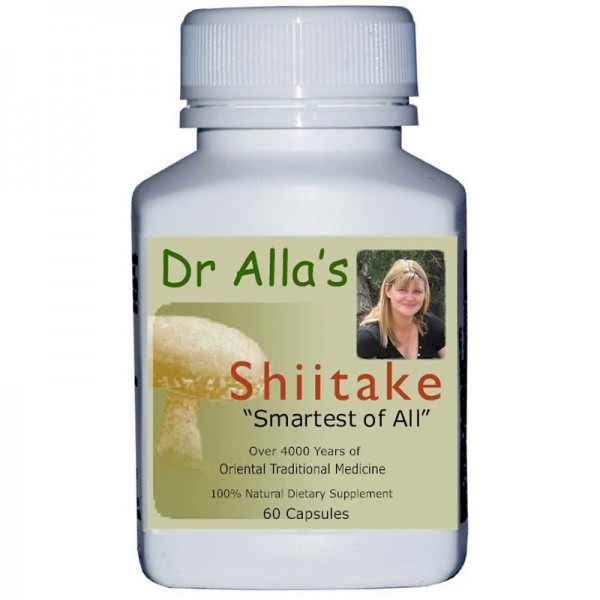
"Smartest of All"
Supports:
- Cardiovascular and circulatory function
- Digestive function and gastrointestinal comfort
- Energy metabolism
- Immune system communication
- Liver function and metabolic processing
- Metabolic balance
- Nutritional support and nourishment
$39 NZD (approx. $25 USD)
60 capsules x 250mg
ATTENTION INTERNATIONAL CUSTOMERS:
IMPORTANT: Our prices are listed in New Zealand Dollars.
You will see the purchase amount in your own currency BEFORE
you complete your checkout on the PayPal or Afterpay payment page.
To order this product, enter your desired number of bottles and click the "Add to Cart" button .
You can also adjust the number of bottles in your shopping cart by using the plus/minus buttons.To add other products to your shopping cart, simply go to that product page and repeat the above process.
Supports
What This Mushroom Supports
Based on its traditional use and the nature of its bioactive compounds, Lentinula edodes has most commonly been associated with support for the following physiological areas:
Cardiovascular and circulatory function
Associated with metabolic and vascular processes involved in lipid handling and blood flow regulation.Digestive function and gastrointestinal comfort
Associated with digestive efficiency, nutrient processing, and support for a healthy gut environment.Energy metabolism
Associated with metabolic pathways involved in energy utilisation and steady energy availability.Immune system communication
Associated with immune signalling and coordination rather than immune stimulation.Liver function and metabolic processing
Associated with hepatic pathways involved in lipid metabolism, nutrient handling, and systemic regulation.Metabolic balance
Associated with processes that support coordination between digestion, energy use, and lipid processing.Nutritional support and nourishment
Associated with providing essential amino acids, fibres, vitamins, and minerals that support foundational physiological needs.
Bioactivities
Bioactive Compounds & Their Physiological Roles
Lentinula edodes, commonly known as Shiitake, has been valued for centuries as both a nourishing food and a medicinal mushroom. Its bioactive profile helps explain why Shiitake has long been associated with immune regulation, lipid metabolism, liver support, and overall metabolic balance.
Shiitake occupies a unique position among medicinal mushrooms because it bridges everyday nutrition and deeper physiological regulation, making it relevant both as a functional food and as a medicinal support.
Polysaccharides (including beta-glucans and heteroglucans)
Shiitake contains several polysaccharides, including β-glucans and heteroglucans, which are studied for their role in immune communication and coordination.
These compounds interact with immune cells involved in recognition and signalling, helping the immune system organise responses rather than pushing it toward overactivity. This supports immune responsiveness while maintaining balance, particularly during periods of physiological stress.
Shiitake’s polysaccharides help explain its long-standing association with immune steadiness and resilience, especially when immune demand is increased by lifestyle or environmental factors.
Lentinan
Lentinan is a distinctive polysaccharide fraction naturally found in Shiitake, and it is one of the compounds most closely associated with this mushroom’s long-standing medicinal reputation.
From a physiological perspective, lentinan is studied for how it interacts with immune signalling pathways, particularly those involved in recognition, coordination, and response. Rather than stimulating immune activity indiscriminately, lentinan is associated with supporting the organisation and communication of immune responses.
This distinction is important. The immune system functions best when it can accurately assess what is happening in the body and respond in a measured, proportionate way. Lentinan is of interest because it appears to support this regulatory intelligence, helping immune cells communicate more effectively with one another rather than pushing them into overactivity.
Lentinan’s relevance also extends beyond the immune system alone. Immune signalling is closely linked with metabolic activity, inflammatory tone, and cellular repair processes. By supporting immune coordination, lentinan indirectly contributes to system-wide balance, particularly in situations where the body is under prolonged physiological or environmental stress.
This helps explain why Shiitake has traditionally been regarded as a mushroom that supports the body’s own organising capacity. Rather than acting forcefully or targeting a single outcome, lentinan aligns with Shiitake’s broader role as a mushroom that nourishes and supports regulation from within.
Eritadenine
Eritadenine is a distinctive amino acid derivative found in Shiitake that has attracted attention for its role in lipid metabolism.
From a regulatory standpoint, eritadenine is associated with pathways involved in how cholesterol is processed, transported, and excreted. Cholesterol handling is closely linked to liver function and metabolic balance, which helps explain Shiitake’s traditional association with cardiovascular and hepatic support.
Importantly, this reflects support for metabolic regulation, not direct alteration of cholesterol levels.
Proteins and Amino Acids
Shiitake provides a rich natural source of proteins and amino acids, including several essential amino acids. Amino acids are fundamental to enzyme production, tissue maintenance, and metabolic regulation.
Their presence supports the body’s ability to repair, adapt, and maintain energy balance, reinforcing Shiitake’s role as a deeply nourishing mushroom that contributes to systemic stability rather than isolated effects.
Vitamins and Minerals
Shiitake contains a broad spectrum of vitamins and minerals, including B vitamins and vitamin D, which are involved in energy metabolism, immune communication, and cellular function.
These micronutrients help support enzymatic processes and metabolic efficiency, strengthening Shiitake’s identity as a functional food with regulatory depth.
Fibres and Supporting Compounds
Shiitake contains dietary fibres, along with additional compounds such as polyacetylenes and nucleoside derivatives, which together contribute to its broader physiological profile.
Dietary fibres play a central role in digestive function and metabolic regulation. They support normal bowel function, influence how nutrients are absorbed, and help create a gut environment that allows beneficial microbial activity to thrive. Because the digestive system is closely linked with immune and metabolic signalling, fibre intake has effects that extend well beyond digestion alone.
From a physiological perspective, fibres contribute to stable energy handling and nutrient processing, helping moderate how quickly nutrients move through the digestive tract and are taken up by the body. This supports steadier metabolic responses rather than rapid fluctuations.
Polyacetylenes and nucleoside derivatives add another layer of support by participating in cellular signalling and enzymatic processes. These compounds help cells communicate and respond efficiently, reinforcing Shiitake’s role as a mushroom that supports coordination across systems.
Taken together, these fibres and supporting compounds help explain why Shiitake has long been valued not only as a medicinal mushroom, but also as a deeply nourishing functional food. Their presence strengthens Shiitake’s relevance in digestive comfort, metabolic balance, and overall gastrointestinal resilience.
How to Think About This Section
Shiitake is best understood as a mushroom that supports metabolic and immune coordination through nourishment. Its compounds work together to support immune communication, lipid handling, liver function, and digestive efficiency - systems that are deeply interconnected.
Rather than acting as a stimulant or a targeted intervention, Shiitake supports the foundational processes that allow the body to regulate itself effectively. This helps explain why it has remained one of the most widely consumed and respected mushrooms across cultures and generations.
Health Uses
Traditional Use & Modern Understanding
Traditional Use & Cultural Context
Lentinula edodes, also known as Shiitake, has been valued in East Asia for centuries as both a staple food and a medicinal mushroom, earning a reputation that bridges everyday nourishment and long-term wellbeing.
In traditional Chinese and Japanese cultures, Shiitake was regarded as a mushroom that supported vitality, circulation, and internal strength. It was associated with the concept of Qi and its smooth movement through the body, particularly in relation to blood flow, digestion, and energy availability.
Unlike rarer medicinal mushrooms reserved for elite or ceremonial use, Shiitake was widely consumed as part of daily life. This consistent dietary use helped establish its reputation as a mushroom that supported health through regular nourishment rather than acute intervention.
Classical herbal writings described Shiitake as strengthening and supportive, particularly in times of fatigue or reduced vitality. Its use was closely tied to maintaining balance in the body, supporting digestion, and sustaining energy over time.
Beyond its medicinal role, Shiitake has long been prized as a culinary mushroom. Its rich flavour, satisfying texture, and nutritional density made it a central ingredient in traditional diets, reinforcing the idea that food itself could serve as a foundation for health.
Modern Perspective
From a modern physiological standpoint, Shiitake stands out for its relevance to immune communication, metabolic regulation, lipid handling, liver function, and digestive health - systems that are deeply interconnected.
Contemporary interest in Shiitake reflects its role as a mushroom that supports metabolic efficiency through nourishment. Its combination of polysaccharides, fibres, amino acids, and specific compounds such as lentinan and eritadenine aligns with pathways involved in immune signalling, cholesterol processing, and energy balance.
Shiitake’s relationship with the digestive system is especially important. Digestive function influences nutrient absorption, immune responsiveness, and metabolic regulation. By supporting digestive comfort and efficiency, Shiitake contributes to system-wide balance rather than isolated effects.
The liver’s role in metabolism and lipid processing further helps explain Shiitake’s long-standing association with cardiovascular and metabolic steadiness. Modern understanding frames this not as direct intervention, but as support for the body’s regulatory processes that manage fats, nutrients, and energy distribution.
Shiitake is also distinctive in that it supports these systems without stimulation. It is not associated with rapid shifts or forced responses. Instead, its value lies in supporting foundational processes that allow immune, metabolic, and digestive systems to function smoothly together.
Seen through both traditional and modern lenses, Shiitake is best understood as a food-medicine - a mushroom that nourishes the body while supporting the systems that maintain balance, resilience, and long-term health.
Components
Nutritional & Naturally Occurring Components
Shiitake naturally contains a broad range of nutrients and bioactive compounds that contribute to its role as both a functional food and a medicinal mushroom.
- Polysaccharides (including β-glucans and heteroglucans)
- Lentinan
- Proteins
- Amino acids (including essential amino acids)
- Dietary fibres
- Vitamins, including B-group vitamins and vitamin D
- Minerals, including iron (Fe), zinc (Zn), manganese (Mn), potassium (K), and phosphorus (P)
- Eritadenine
- Polyacetylenes
- Nucleoside derivatives (including guanosine-related compounds)
CONTACT INFO
021 227 9922 (NZ)
+64 21 227 9922sales@medimushrooms.co.nz
MS Teams: alla.kiroshka
We ship globally to 74 countries and locally to all regions of New Zealand. Local shipping destinations include Auckland, Bay of Plenty, Gisborne, Hawke's Bay, Manawatu-Whanganui, Northland, Taranaki, Waikato, and Wellington on the North Island. As well as Canterbury, Marlborough, Nelson, Otago, Southland, Tasman, and West Coast on the South Island.

Top NZ cities and towns we ship to include Alexandra, Arrowtown, Ashburton, Auckland City, Blenheim, Bluff, Cambridge, Christchurch, Cromwell, Dannevirke, Dargaville, Dunedin, Eltham, Feilding, Gisborne, Gore, Greymouth, Hamilton, Hastings, Havelock North, Hawera, Hibiscus Coast, Hokitika, Huntly, Invercargill, Kaikoura, Kaitaia, Kāpiti Coast, Katikati, Kawerau, Kerikeri, Levin, Lower Hutt, Manukau City, Marton, Masterton, Matamata, Morrinsville, Motueka, Napier, Nelson City, New Plymouth, Ngaruawahia, North Shore, Oamaru, Otaki, Palmerston North, Paraparaumu, Picton, Porirua, Queenstown, Rolleston, Rotorua, Stratford, Taupo, Tauranga, Te Awamutu, Te Puke, Thames, Timaru, Tokoroa, Upper Hutt, Waihi, Wanaka, Warkworth, Wellington City, Wellsford, Westport, Whakatane, Whanganui, Whangarei, Whitianga.
Copyright © 2004 - 2026 MediMushrooms International Ltd
DISCLAIMER: The information on this website has been researched, reviewed and presented with all due care.
Nevertheless, the content is provided for general education and information only and should not be relied upon in making,
or refraining from making, any decision. It is NOT intended to replace medical advice from a healthcare professional.
All users are urged to seek advice from a qualified healthcare professional for diagnosis, treatment and answers to their medical questions.
Use products as directed. If symptoms persist, please see your healthcare professional.Specific results expressed herein are not typical. Individual results will vary.